open Houses

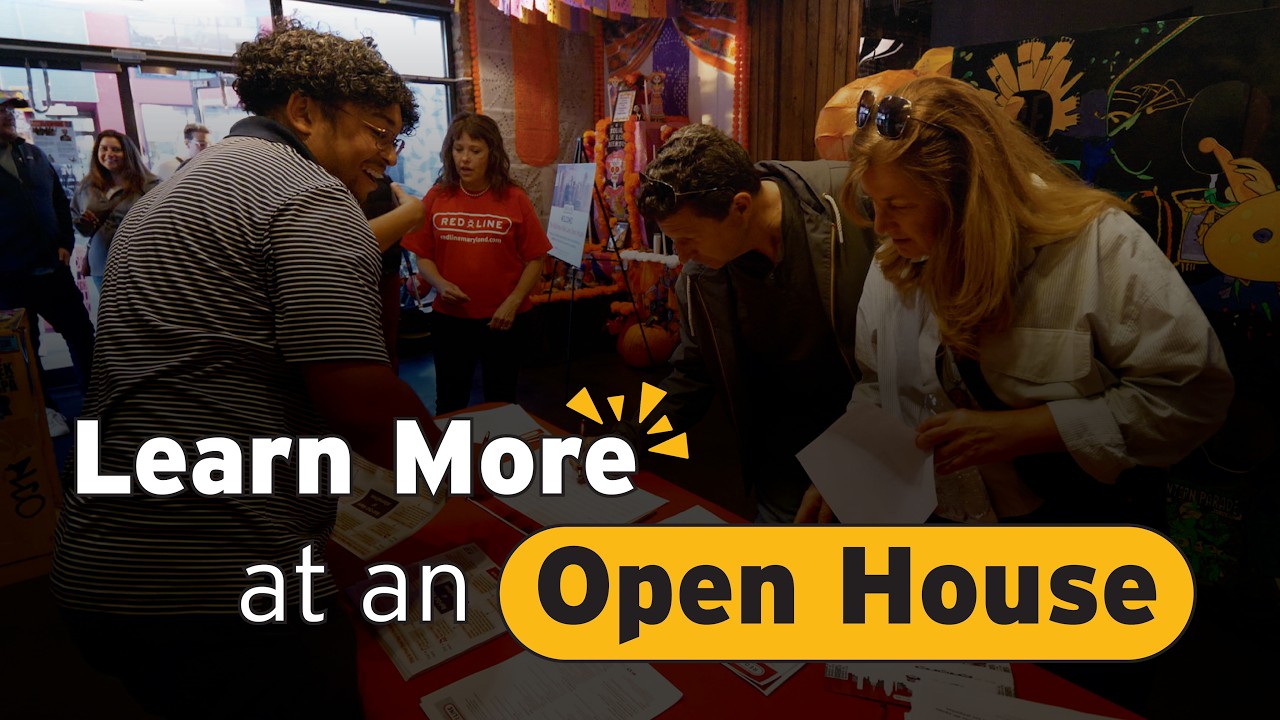
Join us for an Open House May 2-9

Learn More

Join us for an Open House May 2-9!
Learn More

Red Line Baltimore Public Outreach

Red Line Open Houses

The Maryland Department of Transportation Maryland Transit Administration (MTA) has announced a series of public open houses to determine a fiscally responsible path forward for the Baltimore Red Line. The agency will engage community members in May to evaluate alternative delivery strategies, including project phasing and moving forward toward construction.

Your input is essential to MTA’s decision-making on how to move the project forward, taking into account community needs, budget, and time constraints.

Please continue to visit this page for more information and updates about these options and progress.

Read the Press Release

Phasing Options and Mode Selection

The Red Line project team has analyzed alternatives to advance the 14-mile premium rapid transit project while evaluating project costs and funding.

Due to federal funding uncertainty, MTA is evaluating alternative delivery strategies to continue to advance the project.  These additional options include phasing the light rail project by splitting it into smaller portions over time, and revisiting bus rapid transit (BRT) as a potential mode instead of LRT.  BRT could allow the Red Line to be delivered sooner, at a lower cost, and with less property and construction impacts. Completing the Red Line as a 14-mile light rail transit (LRT) project is still under consideration.

Full Light Rail Transit (LRT)

Design and construct the Red Line as currently planned: a 14-mile LRT line, which would cost $4.7B-$9B.

Phased Construction of Light Rail Transit (LRT)

An initial segment from Edmonston Village to Market Place could be designed and constructed for approximately $2.2B with no guarantee if, and when, future phases would be added on.

Bus Rapid Transit (BRT)

Design and construct a high-quality BRT line with similar features of LRT, with a significantly reduced cost of $750M-$1B. Once construction funds are secured, delivery of a bus rapid transit project is only 3 years.

Cost and Years to Complete by Approach

The current cost estimate to construct the full 14-mile light rail transit line is $4.7 billion to $9 billion. By comparison, a proposed first phase of the light rail project from Edmonson Village to the Shot Tower is estimated to cost approximately $2.2 billion. A mode change to bus rapid transit for the entire alignment could reduce costs to an estimated $750 million to $1 billion.

Half of the total Red Line project cost is expected to come from federal sources with the State and local sources funding the remaining balance. Once construction funds are secured, delivery of a bus rapid transit project is only 3 years, reducing the time to deliver a high-frequency east-west transit line with fewer community disruptions and substantial cost savings.

Bar chart titled Cost and Years to Complete by Approach comparing three transit options on two axes: Cost in Billions (left axis, gold bars, $0–$20B) and Years to Complete (right axis, red bars, 0–20 years). Full LRT costs $4.7–$9 billion and takes 9–12 years to complete. Phased LRT is broken into two stages: Phase 1 costs $2.2–$2.5 billion and takes 9 years; Phases 2–3 add $3.7 billion or more and 9 or more additional years, represented by an upward arrow indicating the timeline extends beyond the chart scale. BRT (Bus Rapid Transit) costs $750 million–$1 billion and takes 5 years to complete. BRT is the lowest-cost and fastest option. Phased LRT has the lowest Phase 1 cost of the rail options but the longest potential total timeline. Full LRT has the highest single-phase cost and a mid-range timeline among the three approaches.

How can I provide input?

Community input is essential to MTA’s decision-making on how to move the Red Line project forward. In May, we’ll be hosting public open houses to hear directly from community and you’ll find our team at local events and community meetings. You can find meeting and event information by joining our Email List, following us on social media, and checking out our Meetings and Events page.

Submit a comment via the form below:

CONTACT US

Upcoming Open Houses

Baltimore County:
Saturday, May 2
10 am – 12 pm
Woodlawn High School

Downtown Baltimore:
Tuesday, May 5
3 pm – 5 pm
Baltimore War Memorial

West Baltimore:
Thursday, May 7
6 pm – 8 pm
Edmondson High School

Southeast Baltimore:
Saturday, May 9
11 am – 1 pm
Southeast Anchor Enoch Pratt Library

Glossary of Terms

Alignment
In transit planning this term refers to the specific physical pathway or route that a chosen transit mode will take to connect destinations. It may include travel on the surface, tunnels, or structures (bridge).
Americans with Disabilities Act (ADA)
The Americans with Disabilities Act (ADA) is a federal civil rights law that prohibits discrimination against individuals with disabilities in many areas of public life, including jobs, schools, transportation, and many public and private places that are open to the general public.
Central Maryland Regional Transit Plan (RTP)
The Central Maryland Regional Transit Plan (RTP) is a 25-year plan for improving public transportation in Central Maryland (Anne Arundel County, Baltimore City, Baltimore County, Harford County, and Howard County). The Plan addresses traditional transit (buses and trains) and explores new mobility options and technology.
Community Advisory Team (CAT)
The Community Advisory Team (CAT) is a group of individuals who bring voices and perspectives from the full range of affinity groups and neighborhoods living, working, and investing along the Red Line transit corridor. The CAT is serving as a vital link between the Maryland Transit Administration’s Red Line team's engagement efforts and the diverse communities of the greater Baltimore region.
Community Compact
A collaborative agreement between project stakeholders to ensure the success of the Red Line project by involving community, business, and advocacy group leaders in maximizing community benefits and addressing diverse interests and perspectives.
East-West Regional Transit Corridor Feasibility Study
The East-West Regional Transit Corridor Feasibility Study looked at a corridor serving east to west in Baltimore City and County. It helped identify the potential for high-capacity transit service serving heavily traveled east-west corridors in Baltimore. In particular, the study reinforced the need for enhanced transit in the area now being studied for the Red Line alternatives.
Federal Transit Administration (FTA)
The Federal Transit Administration (FTA) is the part of the U.S. Department of Transportation that provides financial and technical assistance to local public transit systems. The agency supports all types of transit, including buses, subways, light rail, commuter rail, trolleys and ferries. FTA also oversees safety measures and helps develop next-generation technology research.
Light Rail Transit (LRT)
Light rail transit (LRT) is a public transportation system that often uses electric-powered trains to carry passengers in urban areas and is capable of operating in mixed traffic. LRT systems are a modern version of streetcars, but they can carry more passengers, travel faster, and cover longer distances.
Locally Preferred Alternative (LPA)
An alternative (mode and alignment combination) evaluated through the local planning process, adopted as the desired option by the appropriate state and/or local agencies through a public process, and identified as the preferred alternative in the NEPA process.
Maryland Department of Transportation (MDOT)
Maryland Department of Transportation (MDOT) is the overarching agency for state transportation in Maryland. It is led by the Maryland State Secretary for Transportation and includes the Maryland Aviation Administration, the State Highway Administration, the Maryland Port Administration, the Motor Vehicle Administration, and the Maryland Transit Administration.
Maryland Transit Administration (MTA)
The Maryland Transit Administration (MTA) is a state-operated mass transit administration in Maryland, and is part of the Maryland Department of Transportation.
Maryland Area Rail Commuter (MARC) train
The Maryland Area Rail Commuter (MARC) is a commuter rail system in the Washington–Baltimore area. MARC trains are operated by the MTA. The Red Line will have a direct connection to MARC trains at the West Baltimore MARC Station which will be completely rebuilt by Amtrak as part of the Frederick Douglass Tunnel Project with Amtrak.
National Association of City Transportation Officials (NACTO)
The National Association of City Transportation Officials (NACTO) is an association of 100 major North American cities and transit agencies formed to exchange transportation ideas, insights, and practices and cooperatively approach national transportation issues.
National Environmental Policy Act (NEPA)
The National Environmental Policy Act (NEPA) is a federal law that requires federal agencies to consider the environmental impacts of their actions when building or implementing a new project. The goal of NEPA is to lesson or eliminate negative affects of a project.
Park-and-Ride
A park-and-ride is a parking lot where transit users can leave their car and get on a bus or train to transport them to their destination.
Record of Decision (ROD)
A Record of Decision (ROD) is a formal document that summarizes the findings of an Environmental Impact Statement (EIS). A ROD is the basis for a federal agency's decision on a project.
Red Line
The Red Line is the name given to this project. It will be a high-frequency, high-capacity Light Rail line for the Baltimore Region, and it will be an investment in residents’ access to jobs, education, services, and opportunities.
Red Line Operations and Maintenance (O&M) Facility
The Red Line operations and maintenance (O&M) facility will be a central location where trains can be regularly maintained and kept in good condition to run transit service. The facility may also include a storage yard for the trains to "live" in when they are not being used.
Regional Rail Plan
The Regional Rail Plan from 2002 outlines proposed future rail lines for the Baltimore Region. This plan is where the Red Line first appeared on a map and became the basis for the project under development today.
Supplemental Environmental Impact Statement (SEIS)
A Supplemental Environmental Impact Statement (SEIS) is a document that updates or enhances an existing Environmental Impact Statement (EIS). A SEIS is prepared when new information, circumstances, or changes to a project would result in significant environmental impacts that were not considered in the original EIS.
Transit Signal Priority (TSP)
Transit Signal Priority (TSP) is a technology that adjusts traffic signal timing to make it easier for transit vehicles to pass through intersections faster by either extending green lights longer or shortening a red light when a transit vehicle is present.
Tunnel Boring Machine (TBM)
A tunnel boring machine (TBM) is a large mechanical "mole" that is able to dig tunnels deep underground with little to no disruption on the surface except for where the machine enters the ground.
West Baltimore MARC Transit Oriented Development Study (MARC TOD)
The West Baltimore MARC Transit Oriented Development Study (MARC TOD) looks at the potential for future development around the West Baltimore MARC Station. The station will be rebuilt as part of Amtrak's Frederick Douglass Tunnel Project to be fully accessible with elevators and indoor waiting areas. This station will be a key connection hub for local MTA buses, the Red Line, and MARC train service. The area around the station is ideal for development of new housing, retail, and other community-oriented uses that can help maximize the investment in transit.